
Fast and stable operation of websites and web applications is critical for modern businesses, ensuring reliable connections with customers and partners. Cloudflare is considered the largest and most well-known solution provider in this area, serving approximately 24 million active websites worldwide. In this overview, you'll learn how Cloudflare works, what key tools are included in the platform, and its importance for modern web architecture.
What Is Cloudflare and How It Works
Cloudflare is a global server network designed to accelerate and protect web resources from cyberattacks, optimize web traffic, and manage domain names (DNS). Founded in 2009 in the United States, Cloudflare has grown into a global leader in web infrastructure. The platform's data centers are located in more than 330 cities in 125+ countries worldwide.
Cloudflare offers approximately 10 different web services and features, providing website and application owners with a powerful, unified solution for the performance and security of their digital products.
Key platform tools:
- Content Delivery Network (CDN) optimizes content delivery to users by automatically distributing it across 330+ data centers. It allows websites and applications to load faster and with reduced latency.
- Web Application Firewall (WAF). Protects against cyberattacks and other security threats (SQL injection, cross-site scripting) by recognizing and blocking suspicious requests.
- DNS Services. Manages the domain name record system and provides additional options: proxy servers, DNSSEC, DDoS protection, SSL/TLS encryption, WAF, and more.
- Caching. Stores copies of web pages, images, and other content across geographically distributed servers for faster delivery to users.
- Cloudflare Workers. Built-in developer tools make it easier and faster to implement and deploy serverless functions and AI agents into applications.
- Analytics. Tracks, visualizes, and analyzes traffic, performance, security, and other site metrics.
Cloudflare's pricing structure includes the following plans for Application Services:
- Free (DNS, CDN, universal SSL certificate, WAF, 70 rules and 10,000 bulk redirects, unmetered DDoS protection, account control, documentation and forum support).
- Pro (all Free options + lossless image optimization, AMP, 225 rules and 25,000 bulk redirects, forum and ticket support) — $25 per month.
- Business (all Pro options + PCI DSS 4.0 compliance, 100% uptime SLA, 450 rules and 50,000 bulk redirects, support on the forum, via tickets and in chat) — $250 per month.
- Contract (all Business + Network Prioritization features, SSO, 2,700 rules and 1,000,000 bulk redirects, support on the forum, via tickets, in chat, and by phone) — price available upon request.
Speed Optimization: The Performance Side of Cloudflare
Millions of developers and webmasters around the world rely on Cloudflare for website speed and stability. This is enabled by a range of specialized tools on the platform.
DNS
Source: cloudflare.com
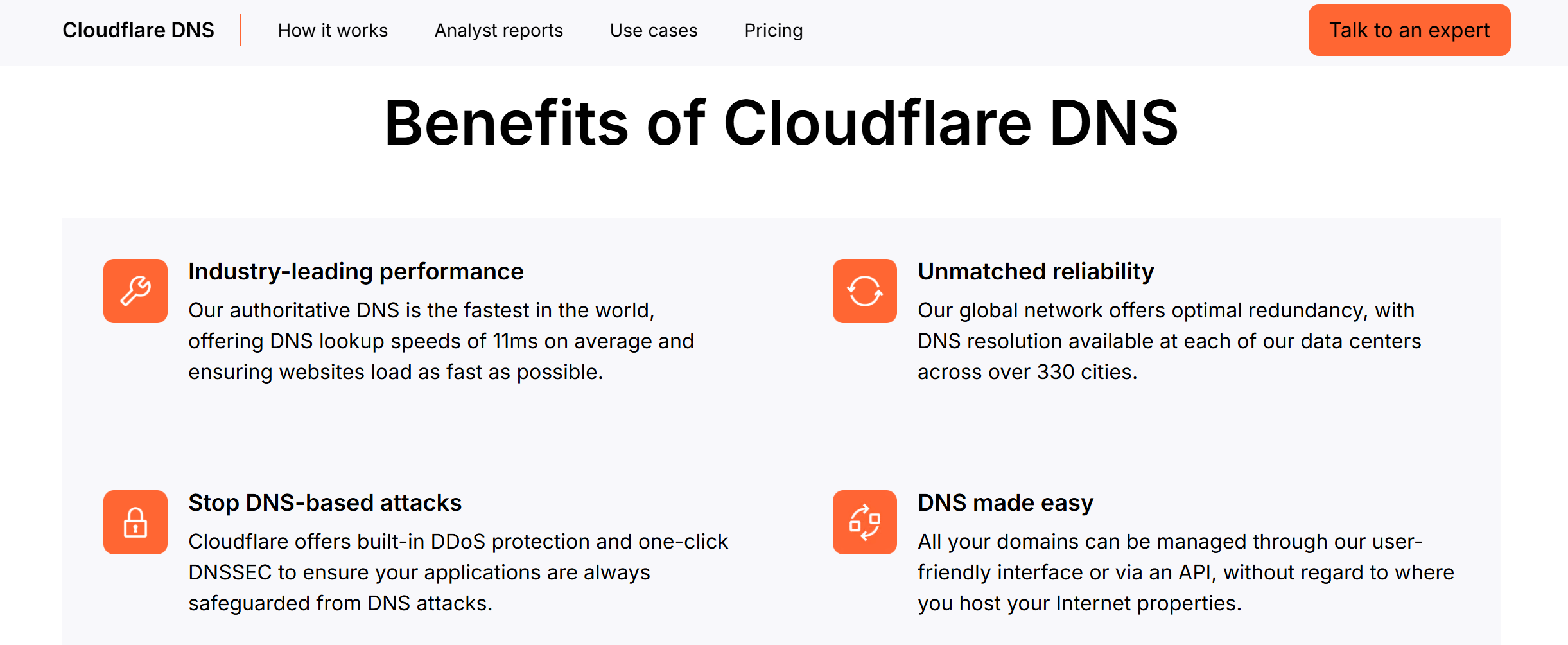
Cloudflare DNS (Domain Name System) delivers the fastest response times (11 ms on average), helping websites load incredibly quickly. Its global network of over 13,000 networks allows the platform to reach the largest number of networks worldwide and reliably prevent cyberattacks.
Users can flexibly manage connected domains via an interface or API. They gain access to enterprise-grade optimization and security tools (built-in DDoS blocker, DNSSEC, SSL/TLS, WAF, etc.).
CDN
The global content delivery network comprises 330 data centers distributed across various countries and regions. It enables website and app users to receive any static and dynamic content within ~50 milliseconds from the platform's closest server.
Cloudflare CDN automatically caches web pages, files, images, videos, and other content hosted on websites and applications. Upon receiving an incoming request, it instantly optimizes the content based on the user's location, device, browser, and internet connection speed.
Edge Caching
Cloudflare copies website pages, images, and other frequently accessed web content and stores it in its geographically distributed data centers (edge locations). When a user requests content, it is delivered from the platform's closest data center, reducing the load on the origin server and lowering website/app load times.
Load Balancing
Load balancing evenly distributes web traffic between network-connected servers and data centers. This eliminates infrastructure overload and maintains website availability in the event of issues with the origin servers.
The platform allows for flexible configuration and adaptation when distributing load between HTTP(S), TCP, or UDP protocols. Its load balancing tools are easily scalable and manageable via a dashboard or REST API.
Polish
Polish automatically optimizes images on websites, removing metadata and compressing them losslessly. When loading content from a website or app, Cloudflare caches it, delivering a smaller, optimized version to the user on subsequent requests. This reduces bandwidth usage, lowers server load, and speeds up website loading.
Argo Smart Routing
The system constantly analyzes internet traffic flows, routing approximately 78 million HTTP requests every second. The data it receives allows it to route user traffic along the fastest routes, monitoring and avoiding congested areas of the network. According to Cloudflare, using Argo Smart Routing improves website and web application performance by approximately 30%, minimizing latency and reducing the load on servers and networks.
Security at Scale: How Cloudflare Defends Websites
Cloudflare security features are a key component of the platform's service ecosystem. They ensure the stable and secure operation of millions of sites, protecting them from cyberthreats 24/7/365.
Securing Web Applications and APIs



The system processes millions of HTTP requests per second, ensuring uninterrupted, secure access to applications and APIs across various hosting environments (on-premise, public/private/hybrid clouds). With its integrated console, machine learning algorithms, and advanced request analytics, Cloudflare improves the effectiveness of security functions by approximately 30%.
Web Application Firewall (WAF)
Cloudflare WAF proactively monitors and analyzes HTTP requests to websites. It detects and blocks attacks and other cybersecurity threats at an early stage, preventing them from reaching the origin server and destabilizing its operation.
Web Application Firewall protects websites and web applications from major types of cyberattacks using machine learning algorithms and other advanced technologies. Its users are reliably protected from SQL injections, cross-site scripting (XSS), zero-day exploits, and other threats.
Bot Management
The platform leverages machine learning, behavioral analysis, device fingerprinting, and other innovative methods to promptly detect and block malicious bots. Cloudflare effectively counters various types of suspicious bot activity, including DDoS attacks, content harvesting, credential stuffing, and inventory hoarding. The system automatically configures and provides recommendations, and also supports custom configuration based on a range of criteria.
DDoS Protection
Cloudflare DDoS protection continuously monitors and prevents distributed denial-of-service attacks 24/7/365 by absorbing and filtering malicious traffic. Its global network capacity (405 Tbps) is 23 times greater than the largest potential DDoS attack. The platform protects web applications and TCP/UDP applications across all protocols, as well as networks, data centers, and infrastructure from Layer 3, 4, and 7 DDoS attacks.
Zero Trust Network Access (ZTNA)
Cloud-based ZTNA verifies and controls remote access for staff and third-party users (contractors, freelancers, etc.) to SaaS and non-web applications to protect infrastructure and MCP servers. It helps minimize the damage from potential attacks by enforcing least-privilege access policies and various authentication methods (clientless options, social identity providers, etc.).
SSL/TLS
Cloudflare provides free SSL/TLS certificates that encrypt data between servers and user devices. This technology reliably protects user data, prevents potential attacks, and minimizes latency to speed up website loading.
Reliability and Incidents
Despite the scale and high resiliency of its infrastructure, Cloudflare, like any global network provider, is not immune to incidents. In 2025, the platform experienced several major outages that temporarily affected popular services and sites worldwide. These outages were caused by configuration errors, updates to network components, and overloads of individual infrastructure segments. Cloudflare promptly resolved these incidents and published detailed postmortem reports, confirming the high level of transparency and maturity of its incident management processes.
Cloudflare’s Role in Modern Web Architecture
To fully understand what Cloudflare does, it's crucial to note the platform's importance to modern web architecture. The company's products, such as Workers, R2, and Pages, play a key role in this area.
Workers
Source: cloudflare.com
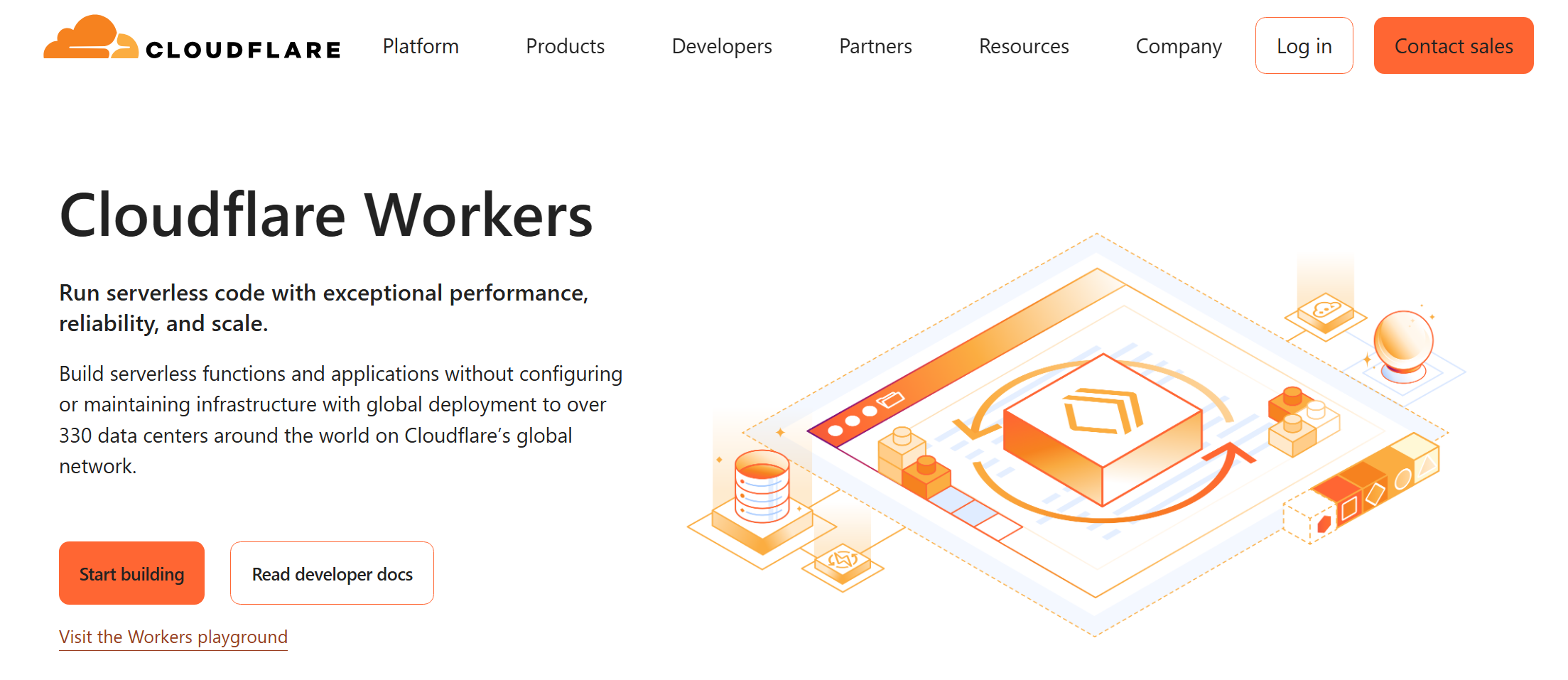
The Workers developer platform provides serverless capabilities, enabling efficient creation, deployment, and scaling of applications across Cloudflare's global network. It supports full-stack development in all popular frameworks and programming languages: JavaScript, TypeScript, Python, Rust, React, Vue, and more. It enables professionals to more easily and quickly develop frontend and backend applications, embedding databases, AI agents, containers, and other features.
R2
R2, an S3-compatible global object storage solution, is designed for storing and processing large volumes of unstructured data. Integrations with Cloudflare and Workers, as well as a wealth of S3 tools, libraries, and extensions, make it the optimal solution for creating portable, multi-cloud architectures.
An automated migration system allows for quick and seamless data migration from other cloud providers. R2 is often used for AI training, storing user-generated or AI content, data analytics, and other tasks.
Pages
The JAMstack frontend development platform significantly simplifies and accelerates the deployment of static websites. This is facilitated by integrations with GitHub, GitLab, and Workers, support for Cloudflare's global edge network, a collaborative workspace with unlimited seats, and other important features.
Pages automatically generates links for each commit and provides comprehensive preview control. Its built-in web analytics tools generate real-time insights on key metrics for your website launches and allow you to quickly share them with your team.
Final Thoughts
Cloudflare is rightfully considered an integral component of the global web infrastructure that accelerates, stabilizes, and secures much of the modern internet. Its diverse range of tools and services, along with its unrivaled platform performance and functionality, make it critical for millions of professionals and companies worldwide.
The benefits of using Cloudflare span several key areas. These include unrivaled network coverage, exceptional reliability, and top-tier security tools. The platform also boasts flexible scalability and a wide range of pricing plans, including a free plan.
The prices mentioned are for monthly subscriptions at the time of writing. Pricing and plan structures may change. For accurate and current information, consult the official website of the services.